Break an event-work day into reporting, travel, service and return segments before assuming a short event means a short commitment.
For event work, ask where the workday begins and ends. An event’s public start and finish times may leave out reporting, preparation, travel and return. You need the whole sequence to check your availability, plus the employer’s explanation of how the actual work and travel are recorded and paid.
In-N-Out’s Cookout job description describes food service from trailers at events and work in the trailer setting. It does not establish a universal reporting base, travel pattern or paid-time rule. The timeline below is entirely fictional and should be used as a question map, not an example of the company’s schedule.
Map an invented assignment
| Segment | Example time | What needs confirmation |
|---|---|---|
| Travel from home to reporting point | 8–8:30 a.m. | Actual reporting address and arrival requirement |
| Report and prepare | 8:30–9:15 a.m. | Who directs the work and how time is recorded |
| Travel to event | 9:15–10 a.m. | Transport arrangement and pay treatment |
| Event-related work | 10 a.m.–2 p.m. | Actual assigned tasks and planned duration |
| Pack up and return | 2–3 p.m. | Expected finish, return point and possible variation |
| Travel home | 3–3:30 p.m. | Reliable trip from the actual release location |
The event-work block lasts four hours, but the fictional home-to-home span is seven and a half hours. That does not establish seven and a half paid hours. It establishes seven and a half hours of personal time committed under the stated assumptions. Paid-time treatment is a separate question that cannot be answered by coloring every segment the same on a diagram.
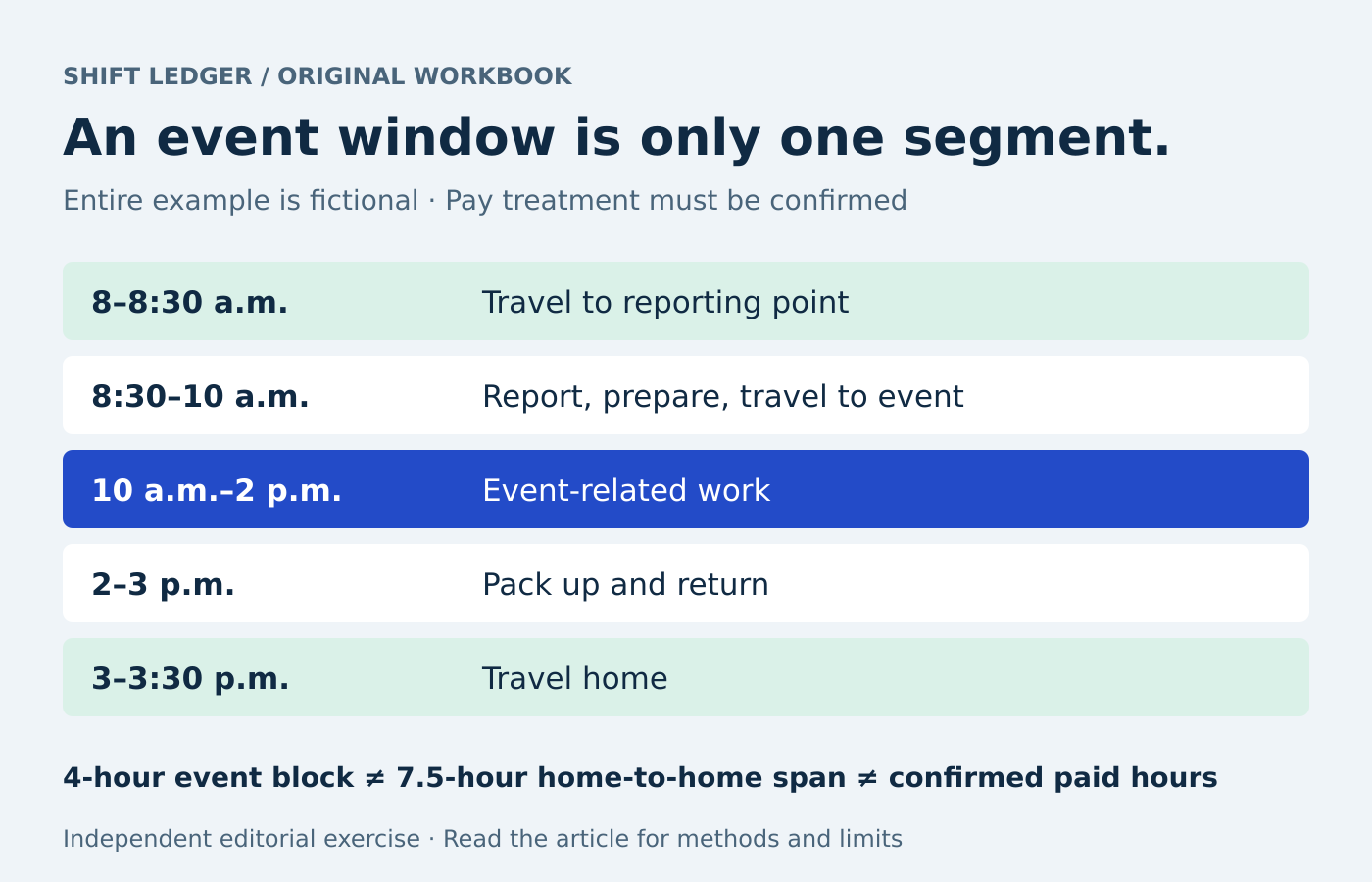
Find the segment that could break the plan
Suppose the applicant must reach another commitment by 4 p.m. A 3:30 p.m. arrival home seems to leave thirty minutes. But that conclusion depends on the return segment finishing at 3 p.m. and the trip taking thirty minutes. If the release location or finish time is uncertain, the thirty-minute margin is not established.
Ask the question at the point of uncertainty: “Where would I report and be released, and what range of finish times should I plan for?” If an assignment can vary, ask how that variation is communicated. Do not present an event advertisement’s finishing time as your availability boundary.
Keep three ledgers separate
- Time ledger: When must you be at each place, and when can you leave?
- Cost ledger: Which transport costs would you personally incur?
- Work/pay ledger: What time and tasks does the employer record, and what terms apply?
Combining them too early creates confusion. Employer-provided transport may reduce a cash expense while still occupying time. A return journey may end somewhere different from the reporting point. A scheduled interval may include circumstances that require a separate pay-rule explanation. Record those details without trying to decide legal compensability from this worksheet.
Compare with a fixed-location alternative
For a hypothetical alternative, imagine four paid hours at one location plus a thirty-minute journey each way. The personal commitment is five hours before any additional onsite time. Comparing that with the fictional seven-and-a-half-hour event day tells you the event day takes two-and-a-half more hours. It does not tell you which job pays more because paid time and rates have not been established for the event case.
That missing answer is the useful result. Ask for the actual terms rather than filling in a wage to finish the table. Once they are known, the commute ledger can compare personal time and entered costs. Keep any employer-specific rules, documents and instructions with the actual assignment.
Take a compact question list into the conversation
Confirm reporting and release locations; the expected start and finish; how changes are communicated; which transport arrangements apply; how work/travel time is recorded; and whom to ask about uncertain terms. You do not need a story about an imagined typical event. You need the details of the opportunity in front of you.