Compare hourly opportunities under different paid-hours assumptions, with worked gross-pay and break-even calculations before tax.
Multiply the hourly rate by paid hours before comparing two hourly opportunities. A higher rate with fewer hours can produce less gross pay. The important uncertainty is often the hours you can reasonably expect, so this worksheet tests a range rather than treating one optimistic week as a forecast.
A higher rate does not settle the comparison
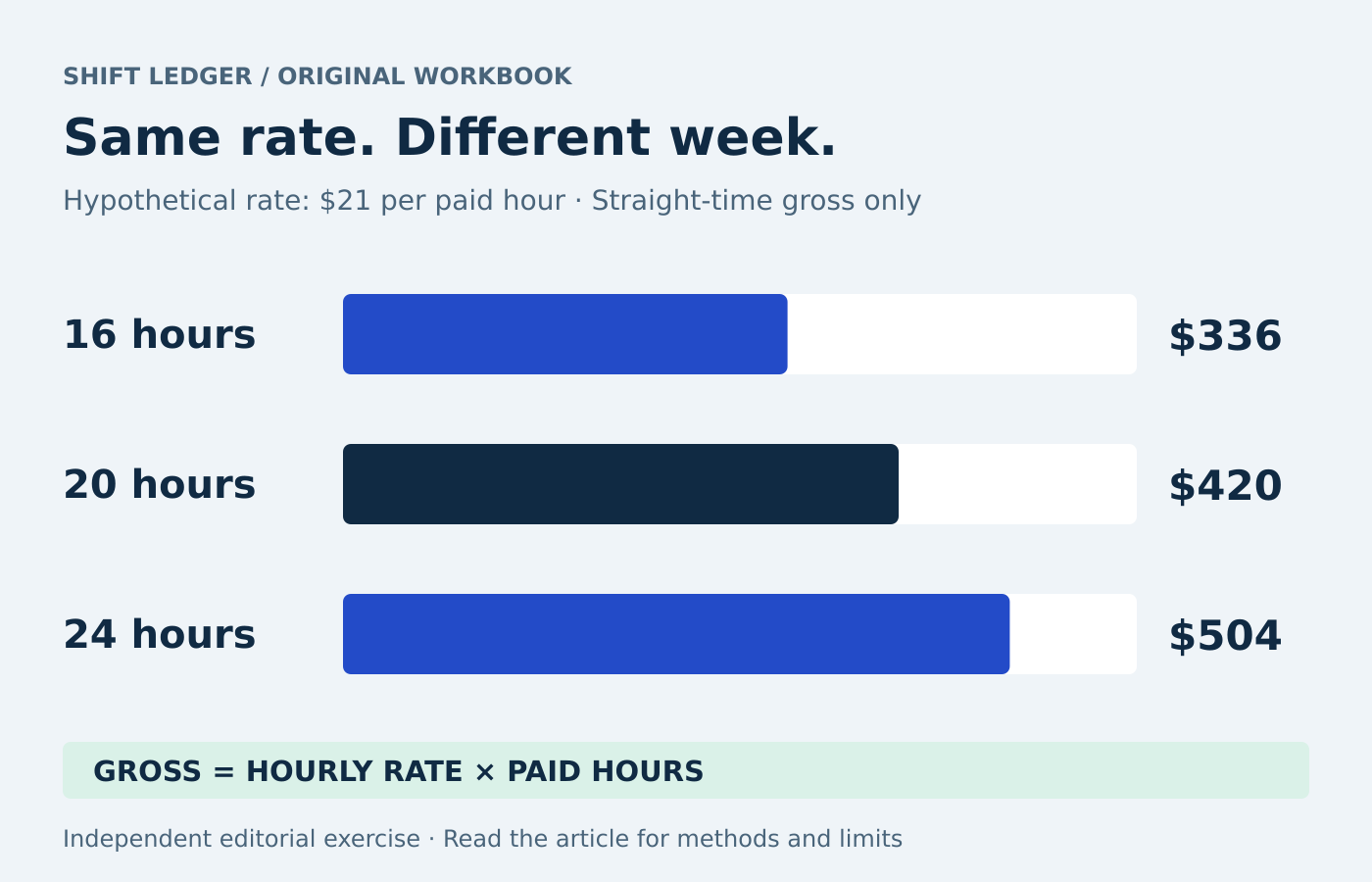
Consider two invented offers: A at $21 an hour and B at $19 an hour. Both figures are teaching inputs, not current employer rates. A is modeled at 16, 20 or 24 paid hours per week. B is modeled at 24 hours. At A’s middle case, gross pay is $420; B produces $456. At A’s higher-hours case, A produces $504. The ranking changes with hours even though neither hourly rate changes.
| Scenario | Offer A: $21/hour | Offer B: $19/hour |
|---|---|---|
| 16 paid hours for A; 24 for B | $336 | $456 |
| 20 paid hours for A; 24 for B | $420 | $456 |
| 24 paid hours for A; 24 for B | $504 | $456 |
The arithmetic is straightforward: $21 × 16 = $336, $21 × 20 = $420, and $21 × 24 = $504. The harder work is labeling the assumptions honestly. If B’s 24 hours are also uncertain, test B at more than one level. Comparing an optimistic A to a conservative B answers a different question from comparing equally cautious assumptions.
Find the hours needed to match a target
To match B’s $456 gross at A’s $21 rate, divide $456 by $21. The answer is approximately 21.71 paid hours. If you compare whole hours, 22 hours at A produces $462. This is a mathematical threshold, not a request the employer must grant and not a prediction about scheduling.
A second threshold starts with your own gross target. For an illustrative $400 weekly gross target at $21, $400 ÷ $21 is about 19.05 paid hours. Twenty whole paid hours would exceed it. A gross target is only a screening tool because the amount available to spend depends on withholding, deductions and expenses. Do not insert your rent into a gross-pay calculator and conclude the bill is covered.
Try the local comparison
Enter rates and paid hours you want to test. Use the separate commute calculator to add travel costs and time. Keep a label beside each scenario in your own notes so an estimate does not become a remembered promise. Inputs stay in the current page and are not saved by this calculator.
Compare rates and uncertain hours
Enter two hypothetical offers, then vary the weekly paid hours. This is flat-rate, straight-time arithmetic before tax. It excludes overtime premiums, differentials, tips, bonuses and deductions. Actual pay rules can differ even below 40 hours per week. These examples are not In-N-Out wage or hours offers.
Hypothetical worksheet only. The package does not send or save these entries. Reset clears this worksheet; your browser may restore form values when you return. Don’t enter private account information.
Why the source date matters
The employer’s Bell announcement stated a $22 starting hourly wage on January 27, 2026. Its Las Vegas Strip announcement stated $18.25 on June 9, 2026. These are dated local examples, not two offers available to you today. They show why copying a rate from another place or time is a poor substitute for checking the current opening.
| Source and date | Role/location | Published amount | Limit |
|---|---|---|---|
| Bell opening release · Jan. 27, 2026 | Opening associates · Bell, California | $22.00/hour | Historical announcement; hours unstated |
| Las Vegas opening release · June 9, 2026 | Opening associates · BLVD, Las Vegas, Nevada | $18.25/hour | Historical announcement; hours unstated |
The two announcements concern different labor markets and opening dates. The $3.75 difference is simply a difference between those two published rates; it is not a company-wide pay gap, a promise of transfer pay or evidence about the cost of living. The worked A/B scenarios above use independent invented inputs rather than applying these historical wages to an imagined offer.
Keep the model narrow
Use paid hours, not the full span between arrival and departure if that span includes time that is not paid. Confirm how the actual schedule and payroll records work rather than guessing. This tool uses straight multiplication and does not determine overtime, premium pay, break treatment or legal entitlement. If those items apply, compare the employer’s documented terms with the relevant official guidance.
Before relying on the result, ask: Are both rates in the same currency? Are both periods weekly? Are both hour figures equally well supported? Would the same number of workdays be required? Then move to the commute comparison, because twenty hours in three visits may be a different practical commitment from twenty hours in five.