Compare two jobs using transport cost and total weekly time, with a worked example that keeps the comparison separate from wages and take-home pay.
Put two travel numbers beside the wage: the money you expect to spend each workday and the minutes for the entire round trip. Multiply both by the number of workdays. This makes a dispersed schedule visible without pretending that commute time is paid work or that a cost-adjusted figure is your paycheck.
Two invented routes, one revealing result
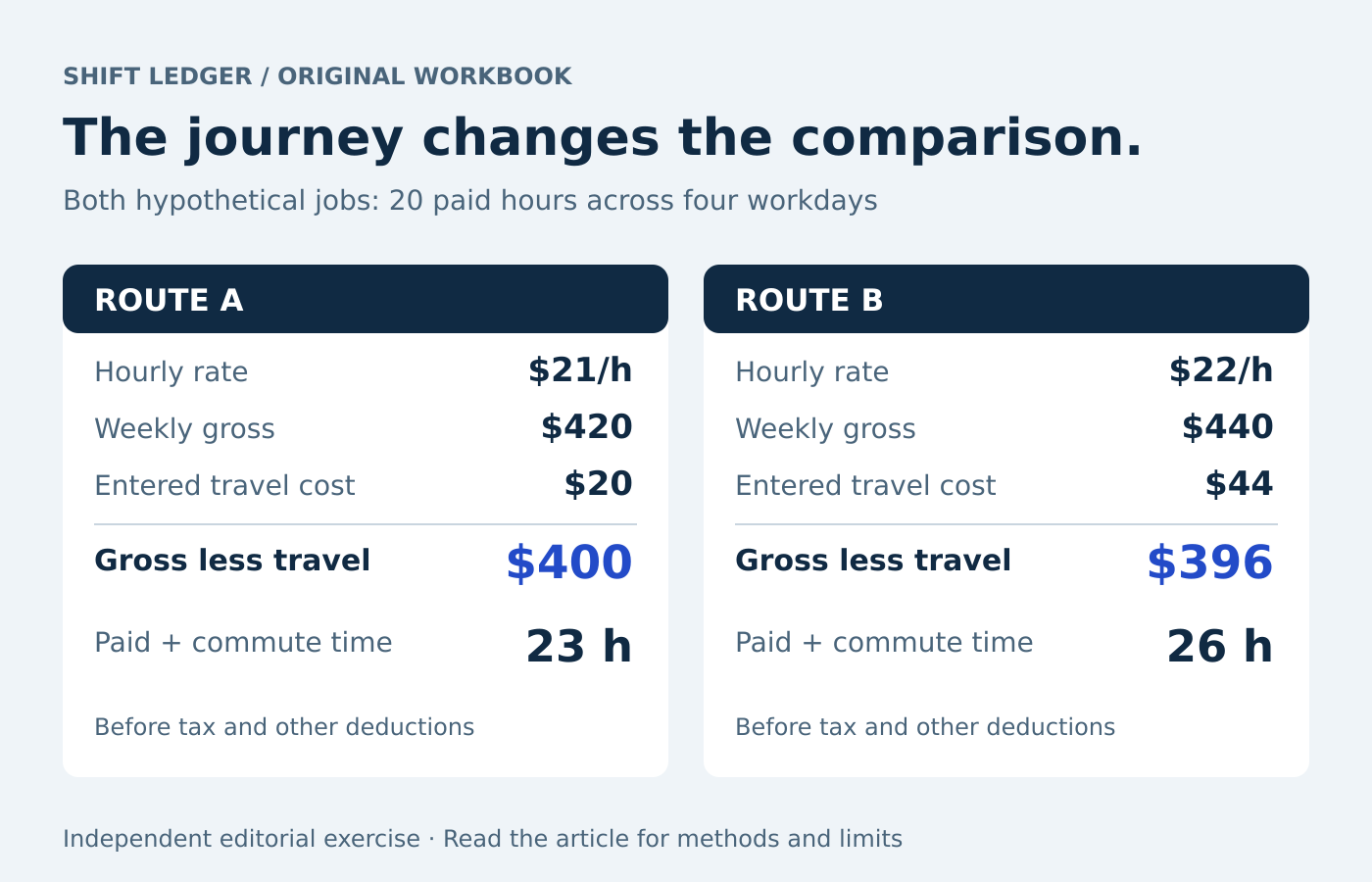
In this example, both opportunities provide 20 paid hours across four workdays. Route A accompanies a $21 hourly rate, costs $5 per workday and takes 45 round-trip minutes. Route B accompanies a $22 hourly rate, costs $11 per workday and takes 90 round-trip minutes. The people, rates, locations and journeys are hypothetical.
| Measure | Route A | Route B |
|---|---|---|
| Gross pay | $21 × 20 = $420 | $22 × 20 = $440 |
| Entered transport cost | $5 × 4 = $20 | $11 × 4 = $44 |
| Gross less entered transport cost | $400 | $396 |
| Commute time | 45 × 4 ÷ 60 = 3 hours | 90 × 4 ÷ 60 = 6 hours |
| Paid hours plus commute time | 23 hours | 26 hours |
| Comparison ratio | $400 ÷ 23 ≈ $17.39 | $396 ÷ 26 ≈ $15.23 |
Route B has the higher advertised hourly rate. Under these assumptions, Route A leaves $4 more after the entered travel expense and takes three fewer hours. That is a useful finding, but it does not settle the job choice. Work setting, reliable hours, benefits and personal preferences still matter. More importantly, the “gross less transport” row remains before taxes and deductions, while the final row is a comparison ratio per committed hour. Neither is net pay, a legal wage calculation or an employer compensation measure.
Keep fares, driving and backups honest
For public transit, use the fare you would actually pay. If an existing pass already covers the trips, decide whether you are comparing extra cash cost or allocating the pass’s full cost. Either can be useful if labeled. Do not charge one route the entire monthly pass and the other only a single fare without explaining why.
For driving, fuel is only one possible expense. Parking, tolls, maintenance and ownership costs may also matter. This calculator does not insert a mileage rate or claim that one number represents your vehicle. Enter your chosen total and state what you included. If a family member drives, a zero fare does not make their time or availability unlimited. Check the arrangement rather than silently treating it as guaranteed.
A backup plan can change the result. Suppose Route A needs one $20 substitute ride in a week instead of its usual $5 trip. Its entered weekly cost rises by $15, from $20 to $35, and the cost-adjusted comparison amount falls to $385. That is a scenario to test, not a prediction of transport failure. Ask whether you could use the backup repeatedly before describing a route as dependable.
Test the real shift times
A route checked at noon does not prove it works before dawn or after a late finish. The employer’s restaurant job descriptions include punctuality. In its FAQ, Clean-Up shifts are described as typically beginning around 5 a.m. or earlier and generally finishing by midday. Exact start and finish times still need confirmation for the opening.
Check the journey at the required arrival time and at the latest plausible departure time using your actual transit operator or route information. Record the last workable departure, a realistic walking segment, transfer risk and any safety concern that changes your decision. Avoid sharing your home address publicly to get a useful comparison.
Try a different workday pattern
At equal 20-hour totals, five workdays require two more round trips than three workdays. With a $5 daily cost and a 45-minute round trip, that difference adds $10 and 90 minutes per week. This is why workdays belong in the model separately from paid hours. It is also why a shorter shift is not automatically a smaller commitment.
Use the local commute calculator below to enter your own scenarios. Then check your arrival and departure window. If the job fits only when every connection is perfect, flag the weak point as a question to resolve rather than rounding the journey down.
Put travel beside the offer
Compare two hypothetical weeks. “Pre-tax remainder” means flat-rate gross minus only the travel cash you enter. It is not take-home pay, an hourly wage or a legal measure of working time. Taxes, other costs and overtime premiums are excluded. Avoid counting a travel expense twice.
Hypothetical worksheet only. The package does not send or save these entries. Reset clears this worksheet; your browser may restore form values when you return. Don’t enter private account information.