Turn commitments and travel buffers into a truthful work window, including a weekly example and a clear way to handle overnight times.
Your availability begins when you can arrive ready for work and ends when you must leave, not when the previous commitment ends or the next one begins. Work backward from the deadlines at both ends. The result is a window to discuss with the employer, not a schedule request the store has accepted.
Calculate Tuesday in minutes
Here is an invented adult student’s Tuesday. Class ends at 2:30 p.m. Travel to the work location takes 30 minutes, and the student allows a 15-minute reliability buffer. Earliest arrival is therefore 3:15 p.m. At the other end, the student needs to be home by 10 p.m. A 30-minute trip home plus a 15-minute buffer means the latest work departure is 9:15 p.m. The feasible window is six hours.
A hypothetical 3–9 p.m. shift fails the arrival test by 15 minutes. A 4–10 p.m. shift fails the departure test by 45 minutes. A 4–9 p.m. shift fits inside the window, assuming its actual start and finish are as described. This calculation does not determine how many of those five elapsed hours would be paid or whether such a shift is available.
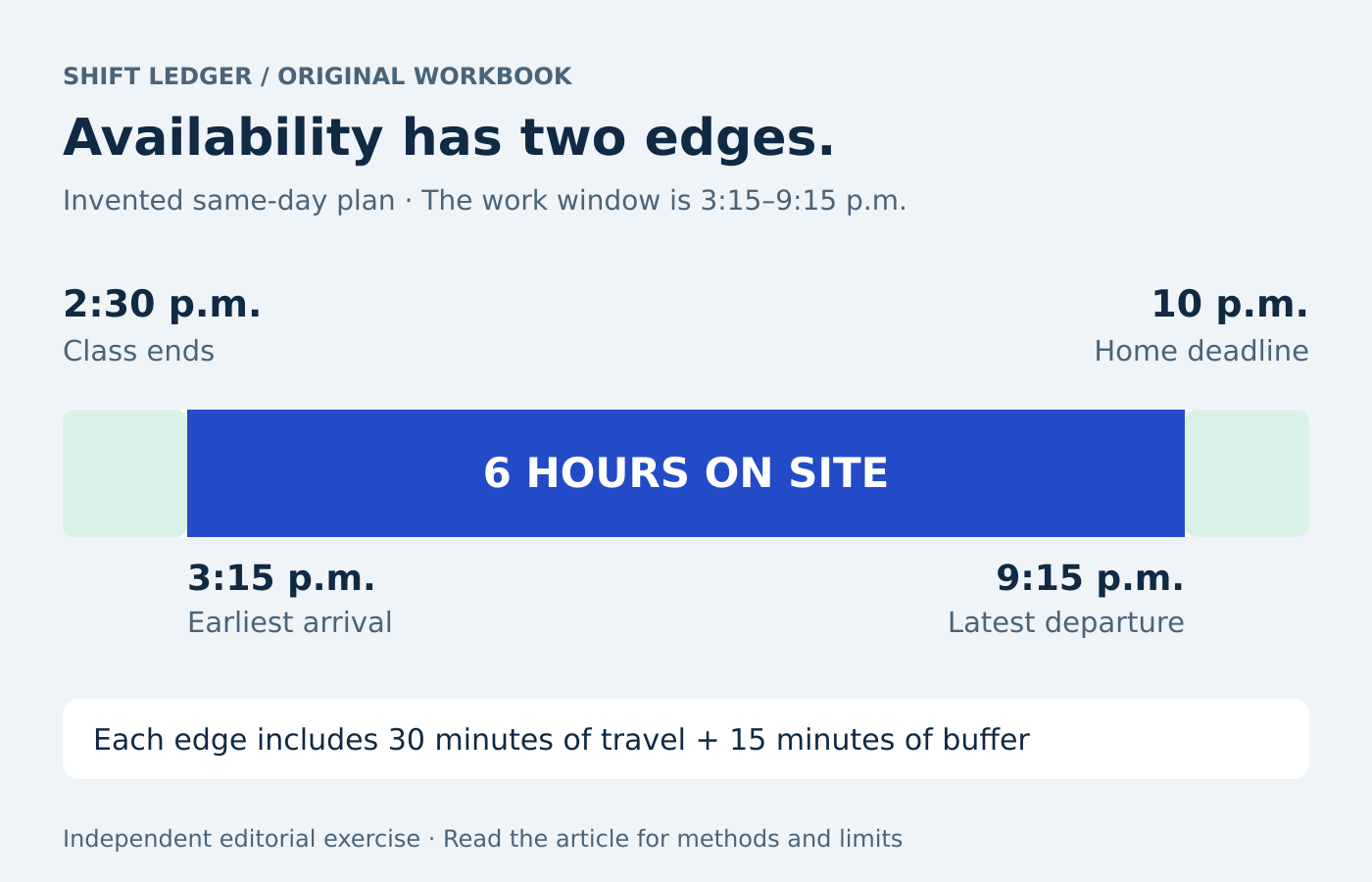
Find the usable time window
Same-day planning only: the latest return must be after the earliest departure. Overnight windows are not supported. The requested onsite duration includes any unpaid onsite interval. This checks a time budget; it does not predict shifts, eligibility or paid hours.
Hypothetical worksheet only. The package does not send or save these entries. Reset clears this worksheet; your browser may restore form values when you return. Don’t enter private account information.
A weekly statement that someone can use
| Day | Can arrive by | Must leave by | Notes |
|---|---|---|---|
| Monday | Unavailable | Unavailable | Fixed commitment |
| Tuesday | 3:15 p.m. | 9:15 p.m. | Class and travel buffers included |
| Wednesday | 4 p.m. | 9 p.m. | Recurring personal commitment |
| Thursday | 3:15 p.m. | 9:15 p.m. | Same class pattern as Tuesday |
| Friday | Unavailable | Unavailable | No reliable return trip |
| Saturday | 9 a.m. | 6 p.m. | Travel checked for both ends |
| Sunday | Unavailable | Unavailable | Protected personal time |
This is more useful than “afternoons and weekends.” It identifies which weekend day is actually possible and avoids offering time the applicant cannot sustain. In-N-Out’s restaurant FAQ tells applicants to state desired availability. Use your real limits in the application and confirm any changes through the employer’s current process.
Resolve overlap before promising flexibility
Consider a second invented case: a class runs until 4 p.m., the trip takes 35 minutes, and another commitment requires departure from work by 6 p.m. Adding a 10-minute arrival buffer creates an earliest start of 4:45 p.m. Only 75 minutes remain. The math cannot tell you whether the employer has a viable assignment in that window. It tells you to ask before calling the whole afternoon available.
Do not solve a conflict by leaving out eating, transport or essential personal obligations. Equally, do not present a preference as a fixed barrier if you would genuinely consider alternatives. Write a separate sentence such as “Saturday afternoon is preferred; morning could be discussed.” A specific preference gives the employer something to respond to without making a promise on your behalf.
Overnight work needs a date
“Until 1 a.m.” is ambiguous unless everyone knows which day it belongs to. Write “Friday 6 p.m. to Saturday 1 a.m.” when discussing an overnight window. The elapsed span is seven hours, not a negative number and not nineteen hours. Whether all of it is paid depends on the actual arrangement.
The planner on this page is limited to same-day windows. It rejects an end time at or before the starting time rather than silently treating it as the following day. For an overnight conversation, write both dates and calculate the two segments on paper: time until midnight plus time after midnight. This prevents a simple typo from appearing to authorize a very long window. If the finish time is unknown, do not substitute the public restaurant closing time; ask when workers in the proposed assignment are normally released and what variation to plan for.
Recheck when the calendar changes
Keep term dates, transport changes and one-off events separate from repeating availability. “I can work this Thursday” and “I can work every Thursday” have different meanings. A useful message states the affected date, the exact window and whether the change repeats. Ask how far ahead the employer wants updates rather than inventing a company notice rule.
This planner is designed for adult logistics, not to determine lawful hours for minors, rest requirements or accommodations. If age-related rules apply, check current federal and state guidance with the employer. For an interview-process access barrier, use the separate request-preparation worksheet.