Make an apply, ask or accept decision with a worked example that keeps personal limits, verified facts and unanswered questions separate.
An attractive hourly rate is only one part of a workable job. Before deciding, test three things: whether you can reliably do the work, whether the time and money fit your life, and which missing answer could reverse your choice. A good decision record ends with a next action. It does not need a perfect score.
This workbook follows an invented adult applicant, Casey. The person, opportunities, wage, schedule and travel figures below are hypothetical teaching examples. They are not an In-N-Out offer or a description of a particular store. The method can be used alongside the employer’s public information, then completed with the details you actually receive.
Begin with the condition that would stop you
Casey has classes until 2:30 p.m. on Tuesdays and Thursdays, needs to be home by 10 p.m. those nights, and can work Saturdays. A shift ending at 10 p.m. would not fit: getting home also takes time. That is a limit, while preferring Saturday mornings to afternoons is a preference. Mixing the two produces a misleading comparison in which a high wage appears to compensate for a schedule that is impossible to keep.
Write no more than three hard constraints first. Examples include a fixed class, a confirmed transport cutoff or a minimum amount of paid work you need to make the decision viable. Be precise about what is truly fixed. A hope for twenty hours is not a confirmed twenty-hour schedule. An uncertain ride is not a reliable travel plan.
| Question | Evidence now | Decision effect |
|---|---|---|
| Can the work fit? | Tuesday/Thursday: earliest arrival 3:15 p.m.; latest departure 9:15 p.m. | Ask whether actual shifts fit inside that window |
| What would the money be? | Hypothetical $21 × 20 paid hours = $420 gross/week | Useful scenario; hours are still unconfirmed |
| What does travel add? | Four round trips of 45 minutes and $5 each | Three travel hours and $20 weekly cost |
| What is the remaining unknown? | No clear answer on usual finish time | Do not conclude the schedule works yet |
| Next action | Ask one specific scheduling question | Keep researching other feasible options |
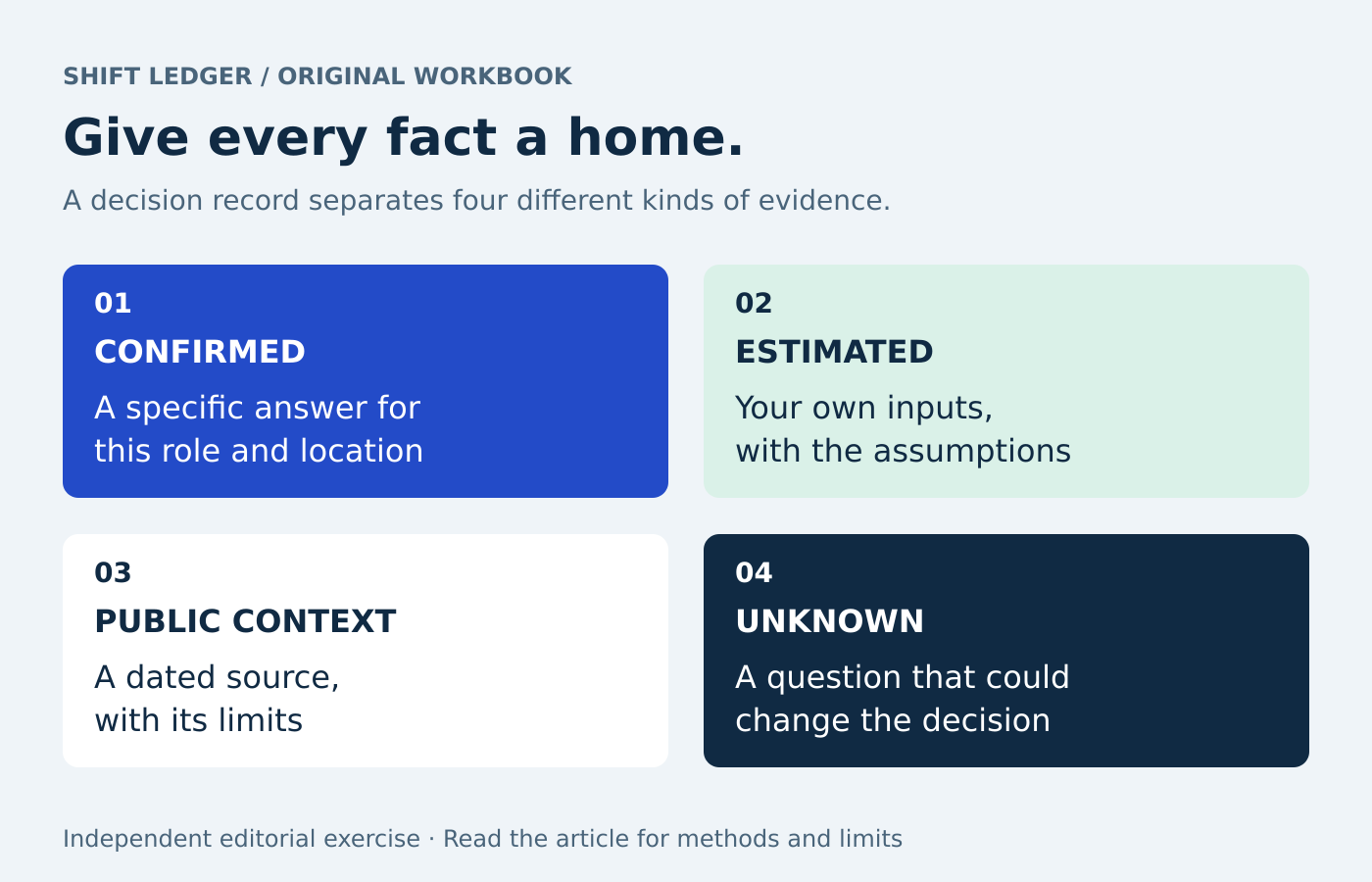
Give every entry an evidence label
Use “confirmed,” “my estimate,” “public background” or “unknown.” This simple labeling prevents a public company statement from silently becoming a personal promise. In-N-Out asks applicants to provide availability and describes flexible shifts in its restaurant FAQ. That establishes a useful topic for a conversation; it does not confirm Casey’s desired shifts.
A source should travel with the claim. For a direct answer, record the date, the role and the person or office that supplied it in your private notes. For a public statement, save the exact URL and any publication date. For your own estimate, write the inputs. “The commute is okay” is difficult to test. “Three trial routes took 38–47 minutes at the relevant time” gives you something to revisit.
Work through one numerical comparison
Suppose the hypothetical job offers $21 per paid hour and Casey models 20 hours over four days. Gross weekly pay is $420. Subtracting only $20 of entered travel cost leaves $400 before taxes, deductions and other expenses. The time commitment is 23 hours: 20 paid hours plus three commuting hours. Dividing $400 by 23 gives about $17.39 per committed hour. That last number is an editorial comparison ratio, not an hourly wage or take-home pay.
Now test a less favorable week. At 16 paid hours across the same four days, gross becomes $336, the same travel cost leaves $316, and committed time becomes 19 hours. The ratio is about $16.63. Neither scenario proves how many hours Casey will receive. Together, they reveal why the hours question matters. Use the hours worksheet and commute ledger to change one assumption at a time.
Use three outcomes instead of an artificial ranking
- Apply: the known work and logistics fit well enough to explore, and you have honest evidence to bring.
- Ask: one missing detail could change the choice. Write the question and keep the decision open.
- Accept or decline: you have actual terms and enough clarity to make your own choice. Read the employer’s documents before communicating a commitment.
Casey’s result is “ask.” A useful question is: “On Tuesdays and Thursdays I could arrive at 3:15 p.m. and would need to leave by 9:15 p.m. Are there shifts for this opening that fit those limits?” The answer may be yes, no or not yet known. The workbook succeeds in all three cases because it identifies the decision that the public website cannot make.
Your blank record
- Write the exact role and location being considered.
- List your fixed limits and your negotiable preferences separately.
- Enter a low, middle and high paid-hours scenario with a stated hourly rate.
- Add travel cost and time using your own route information.
- Mark each important fact as confirmed, estimated, public background or unknown.
- Name the single missing answer with the greatest effect.
- Choose the next action and a sensible point to revisit it.
Use a private notebook or your own document. This publication does not need your address, school details, employer records or financial commitments. After an interview, the evidence debrief helps update the record without turning a friendly impression into an agreed term.