Compare your original job assumptions with two weeks of observed hours, travel and learning support, then choose a focused adjustment conversation.
After you have some experience of the actual job, revisit the assumptions that mattered when you accepted it. Use a short period you can describe accurately. Two weeks is a practical editorial checkpoint, not a claim that the employer holds a two-week review or that every pattern becomes clear that quickly.
Compare the same measures
The invented worker below expected 20 paid hours across four days, a 45-minute round-trip commute and a known person to ask when a task was unfamiliar. The table records two fictional weeks. It does not describe a particular store, employee or training system.
| Measure | Planning assumption | Week 1 | Week 2 |
|---|---|---|---|
| Paid hours | 20 | 18 | 22 |
| Workdays | 4 | 4 | 5 |
| Round-trip travel total | 180 minutes | 200 minutes | 260 minutes |
| Task questions | Know who to ask | Contact clear on most shifts | One shift began with contact unclear |
| Personal concern | Protect an evening commitment | No conflict | One finish time needed clarification |
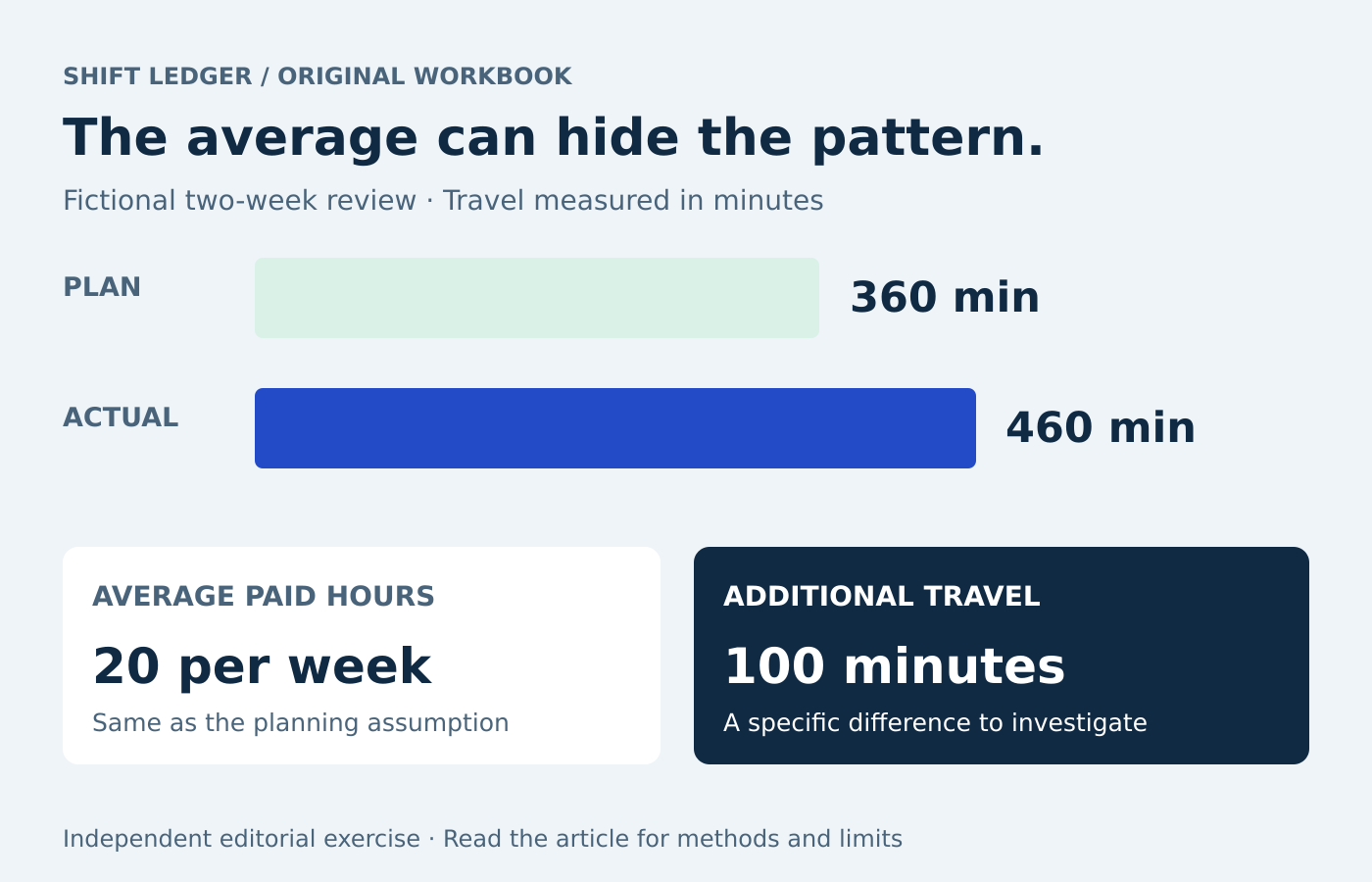
Across the two weeks, paid hours average 20, matching the original assumption. Yet the workday count and travel time are higher in week two. The average alone hides that difference. Total travel is 460 minutes, compared with the planned 360 across two weeks: 100 additional minutes. This is a useful observation without being proof that the pattern will continue.
Classify a difference before reacting to it
One-off: You know the cause was unusual, such as a transit delay on one date. Possible pattern: It recurred, but the observation window is still short. Confirmed change: The relevant person has told you the arrangement changed. Unknown: You do not yet know the cause.
These labels prevent both overreaction and wishful thinking. Do not call a repeated issue a one-off just because you hope it will disappear. Do not call one unclear shift an established workplace policy. Record the dates and the practical effect, then ask the person who can explain it.
Choose an adjustment you can describe
For the fictional worker, a useful conversation might be: “In the second week I worked five days rather than the four I used in my travel plan. Could we discuss the likely number of workdays for the next schedule? I’m trying to make sure my availability remains realistic.” The employer may or may not be able to offer the requested pattern; the message asks for clarity rather than assuming a right to a particular schedule.
A learning-support question should be equally specific: “When I start a shift with an unfamiliar task, who should I check with before beginning?” In-N-Out’s public job descriptions emphasize following instructions and working with others. That broad expectation does not identify your actual trainer or private escalation process. Confirm the local arrangement.
Separate fit from safety
A longer commute or a changed workday pattern can usually be discussed as a fit question. An immediate hazard, missing safety instruction or urgent health concern should not wait for a scheduled personal review. OSHA’s restaurant safety resource emphasizes hazard information and training. Follow workplace emergency procedures and use appropriate emergency help when needed.
This worksheet does not instruct you to continue an unsafe task to gather more data. It also does not diagnose fatigue, a medical problem or a workplace violation. Its role is to compare ordinary planning assumptions with observed experience and identify the next responsible question.
Update the decision instead of rewriting the past
Keep the original assumption visible and add what you learned. “I expected four days; the last schedule had five” is clearer than remembering that you always knew it would be five. A decision made with limited information can reasonably change when the information changes.
End with three lines: what still fits; what needs clarification or adjustment; when you will revisit the answer. If you need to make a larger employment decision, return to your actual terms and personal constraints. Do not let a fictional workbook decide for you, and do not treat two weeks as a universal deadline to stay or leave.