Audit an unexpected hiring message before sharing identity or payroll details, using independently reached official sources rather than the message itself.
Verify the contact before you supply sensitive information. Start from the employer’s official website or a contact you already established through a legitimate application. A message’s logo, familiar wording or knowledge of your name is not enough to prove who sent it.
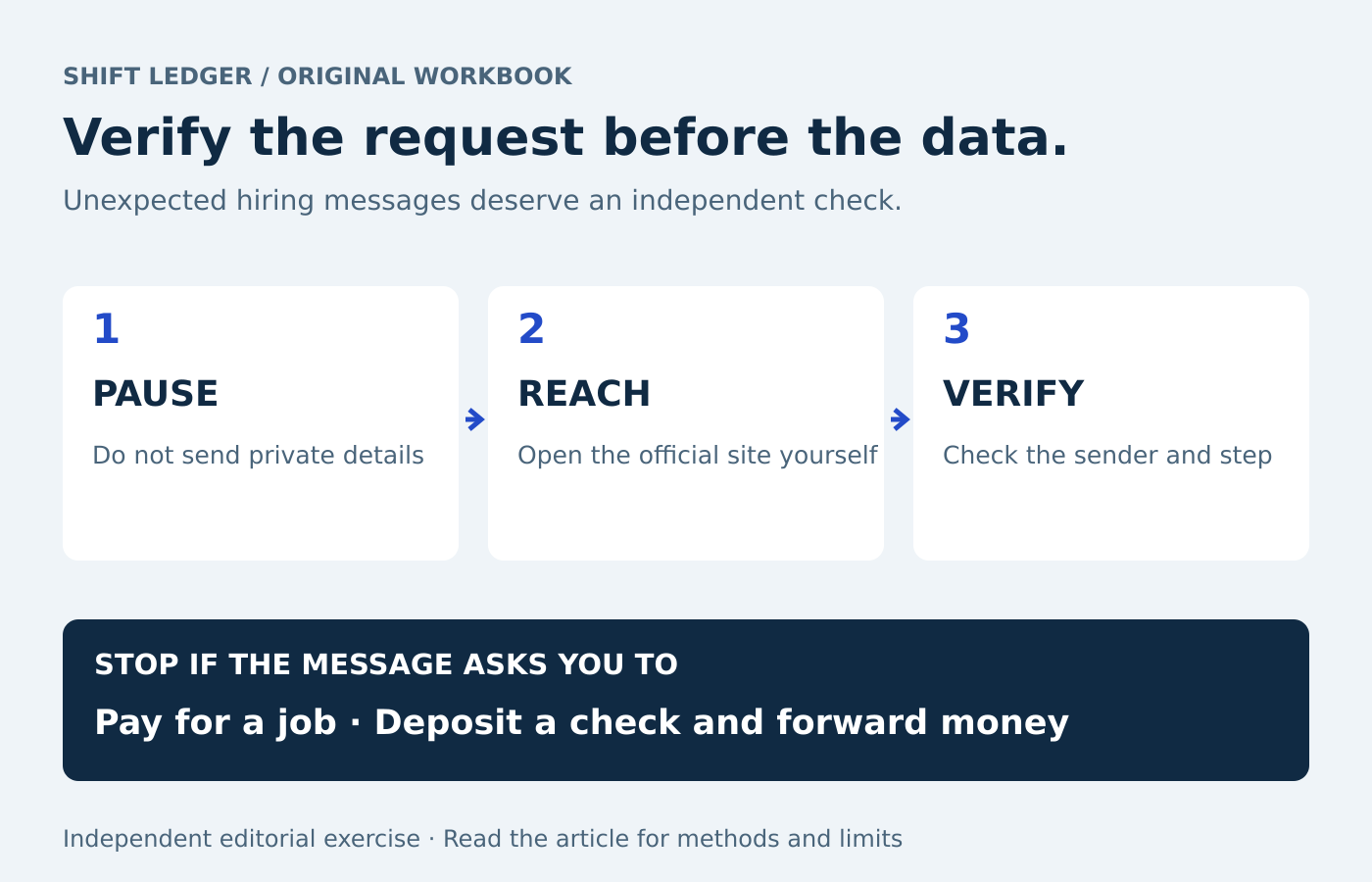
The FTC’s job-scam guidance warns against paying for a promised job and against depositing a check then forwarding money. Those are reasons to stop the transaction and investigate, not administrative steps to complete quickly. This article does not claim that the fictional messages below were sent by In-N-Out or that a specific current recruitment campaign is fraudulent.
Message one: familiar details, unverified request
Invented message: “Thanks for applying for an associate position. We can move you forward today. Use this form to send your identity documents and banking details before we schedule your interview.”
The message mentions a role the applicant recognizes, but the request still needs verification. Do not use the embedded link as the proof of legitimacy. Open the official employer employment page independently, follow the relevant hiring route and contact the organization through a verified channel. Ask whether the sender and requested step belong to the actual process.
Matching an application detail may make the message plausible; it does not make the transmission safe. Likewise, a domain can look similar while belonging to someone else. Focus on independently establishing the contact and destination rather than trying to judge every technical detail from appearance alone.
Message two: a payment condition
Invented message: “Your job is guaranteed after you pay a training deposit. We will reimburse you from a check we send, and you should forward the remainder to our equipment supplier.”
This combines the payment and fake-check patterns described by the FTC. Do not pay, deposit the check or forward money to complete the supposed hiring step. Preserve the message for a report without clicking more links. A promise of reimbursement does not remove the risk.
A small verification record
| Question | Reliable next step |
|---|---|
| Did I apply for this exact role? | Compare with your own application record; do not rely on the message’s claim |
| Is the sender part of the process? | Ask through a channel reached independently from the official site |
| Is the requested information needed now? | Ask what step it supports and which secure route is authorized |
| Is money being requested? | Pause and compare with the FTC’s job-scam warnings |
| Has the destination been verified? | Use the confirmed route, not an unsolicited replacement link |
The record can stay brief. Keep the date, the role and how you independently checked the request. Do not make a new document containing your Social Security number, bank account or identity scans merely to prove you performed the check. This publication neither collects those details nor provides a verification service for individual messages.
Do not let urgency supply the missing evidence
“Today only” or “respond in ten minutes” may make a request feel important, but it does not authenticate it. You can ask the verified employer contact whether there is a real deadline. If you cannot verify the contact, leave the request unresolved rather than sending private information to avoid an imagined lost opportunity.
If a legitimate contact confirms the process, follow the employer’s actual secure instructions. Verification does not mean that every future link from a similar-looking sender is automatically approved. Recheck a material change in destination, data requested or payment demand.
If information or money has already been sent
Act promptly using official recovery guidance. The FTC page links steps for reporting job scams and responding after payment. Contact the payment provider through its own official route to report a suspected fraudulent payment and ask what options exist. If identity information was exposed, use the FTC’s linked identity-theft guidance. Do not pay a second person who promises guaranteed recovery.
Once the contact is verified and actual terms arrive, move to the evidence sheet or offer reply workbook. Those are decision tools; they cannot substitute for establishing who is asking for your information.